

Latest Issue
 
Windtech International November December 2025 issue
 

Login

 Follow us at BlueSkyFollow us at BlueSky


follow


Aevento Figure 1 Steel and Concrete TowerHigh-Altitude Modular Post-Tensioned Concrete Wind Towers

In the race for efficiency and innovation, the wind energy sector is rethinking the very shape and logistics that define its towering giants. The industry has focused on the circular shape for towers because of its low aerodynamic drag coefficient. What if, thinking outside the box, this shape were dropped from the overall design and a new approach similar to buildings was accessed? Imagine wind towers that rival the height of city landmarks, harnessing greater wind capacities while revolutionising transportation logistics. Could these giants be modular, swiftly transported like ubiquitous shipping containers, seamlessly moving across road, rail, oceans and even the skies? The challenge extends beyond mere height – it is about speed and scalability. Can wind towers be prefabricated in factories and assembled with automotive efficiency? These questions push boundaries, urging us to shatter conventional paradigms while leveraging the very strengths of standardised container logistics.

By Andrés de Antonio, Aeventor, USA

Steel tube towers, standing on average between 100 and 120 metres tall, feature conical steel sheets up to 4,000mm in diameter and 25 to 50mm thick. Transporting them requires special permits, strict schedules, and safety vehicles. Concrete, hybrid, and wood alternatives circumvent transport challenges, yet on-site assembly poses weather and structural risks, demanding heavy equipment and labour-intensive handling. A new approach for fabrication, transportation and erection is boldly needed.

Aevento Figure 2 Two reachstackers with modulesFast-Paced Fabrication in Factories
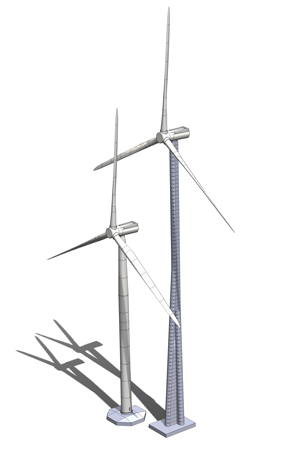
The proposal is a prefabricated and post-tensioned high-performance concrete with fibres, tower based on modules transportable by ship, train, truck and, in particular cases, cargo aeroplanes. Measurement of the modules complies with ISO measurements for transportation and weight. Based on the number of modules, the tower is scalable from heights of 100 to 215 metres. In this last concept, the tower is able to sustain a second wind turbine. If higher heights are required, a concept of a guyed tower (tower with cables at different heights) is also an option.

The modules arrive completely assembled; there is no need for pre-assembly procedures. The concept is based on a completely industrialised production, in which the modules arrive at the site simply for stacking and assembly. Structurally speaking, the modules are provided with a top slab that provides additional flexural rigidity and acts as a diaphragm similar to that in a building; in the construction process, this translates into a working platform for workers during assembly. These wind towers have the structural capacity to sustain wind generators of higher energy production and higher weights, aiming at existing wind turbines of 5MWh, 10MWh, 20MWh and beyond. The foundation concept relies on prefabricated modules as well. Wind tower frequencies can be tuned with variations in slab thickness and wall thickness. Having a completely industrialised process, costs are also significantly reduced. These high-resistance, post-tensioned concrete modules are assembled, poured and cast in factories and designed for efficient transportation by truck, train and ship, employing the maritime container size restriction of 2,438mm × 3,800mm × 12,192mm (width × height × length).

Aevento Figure 3 Semi Trailer and Rotating DollyThe Shape Outside the Box
Wind modules will have a general rectangular prismatic shape, each having a frontal curved face, assembling tabs or clefts of lateral and upper modules. In the same manner, modules of each assembly will be the same height. The general configuration of the wind tower will be pyramidal, i.e. the length of modules will diminish as height increases. The frontal curved face of the modules increases the structure’s aerodynamics in the most prominent wind direction. All the modules are hollow. This allows a construction or assembly crew to be inside for the assembly. The interior includes a staircase, while current wind towers only include vertical ladders. The tower has openings that allow elevators, electrical and mechanical conduits, among others to facilitate the assembly. In this manner, no temporary platforms are required during assembly of the towers, increasing efficacy and safety. The union of modules is done through high-resistance bolts and the tower is compressed through post-tensioning strand cables once the final module is on top, allowing a compression-only structural state even under major lateral flexural stresses. The foundation is also preassembled. Various modules can be assembled together to form a superficial foundation or they can be provided with perforations to allow piles to be embedded within.

Aevento Figure 4 Assembly Jaegger Transport CraneMultimodal Transportation and Handling
In order for the transportation to be successful, the pieces have to be restrained to the maximum measurements for maritime containers: 12,192mm in length with a potential to be extended to 16,155mm as super high cube containers; a width of 2,438 to 2,591mm, which is the typical transportation width in most countries; and a maximum height of 3,800mm – the piece is separated by 200mm from the ground through special dollies but still fits within the maximum height restriction for bridges and tunnels of 4,000mm in most countries. Tower modules can be transported at normal speeds of 95km/h (~60mph) on main roads (modules do not exceed the size limitations) compared with 40km/h (~25mph) for steel tube towers, which also require safety cars. The modules have special corner fittings that align with international container standards for shipping containers – ISO 668 (Classification, Dimensions and Ratings) and ISO 1161 (Corner Fittings) – which allows the pieces to be manipulated through standard crane spreaders (included in reach stackers or port cranes) both in their horizontal final position and their vertical transportation position.

Aevento Figure 5 TOWER WITH CRANE TURBINE Fast-Paced Controlled Safe Erection
The system also comprises an escalating crane (963-metric-ton capacity) that engages on the back side of the modules. It includes a spreader mechanism held by four or more cables offset from each other (instead of typical cranes that engage through a hook), providing great stability and manoeuvrability. The end of the spreader engages with the corners of the modules through twist-lock mechanisms. Through special ‘plug and play’ fixtures, this same escalating crane can hold the massive wind turbines as well as each of the three blades and put them into place in a controlled manner. The escalating crane through its retractable worm structure extends and retracts in order to reach different heights of the tower. The escalating crane has a spreader-type structure that, with the use of industry standard twist locks, attaches to, and detaches from, every single module through a mechanical lock. The whole crane is assembled within a time span of 6 hours, employing hydraulic cylinders and rotary and linear actuator locks. The crane is transported in five pieces through the employment of four 10-axle, heavy transport carriers and disassembled automatically within the same time span.

Transforming Wind Tower Architecture
Picture wind towers reaching skyscraper heights, modular and swiftly transportable like standardised shipping containers both onshore and offshore. This vision not only promises greater wind capacity but also challenges current transportation norms across road, rail, sea and air. The quest is not merely about scaling heights; it is about reimagining speed and scalability. Can wind towers be prefabricated with automotive efficiency, assembled like building blocks of the future? These questions compel us to break free from conventional paradigms while harnessing the logistical genius of standardised containers. As we ponder these possibilities, we acknowledge that true innovation often emerges at the intersection of daring imagination and pragmatic execution. The future of wind energy beckons us to innovate boldly, leveraging the transformative legacy of container logistics that forever changed global transport.

Further Reading
Levinson, M. 2016. The Box: How the Shipping Container Made the World Smaller and the World Economy Bigger. Princeton, NJ: Princeton University Press.

Biography of the Author
Andrés de Antonio, a US-based structural engineer, has a master’s degree in high-performance structures from Massachusetts Institute of Technology. He gained experience in skyscraper design from renowned structural engineering firms like Arup and Skidmore, Owings & Merrill before further developing his career in the structural engineering design of wind concrete tower prototypes for Vestas, Siemens, GE and other industry leaders. Licensed as a professional engineer in multiple states, he leads Aeventor Modular Wind Towers. Andrés holds patents in modular construction, multimodal transportation and escalating heavy cranes.

Use of cookies

Windtech International wants to make your visit to our website as pleasant as possible. That is why we place cookies on your computer that remember your preferences. With anonymous information about your site use you also help us to improve the website. Of course we will ask for your permission first. Click Accept to use all functions of the Windtech International website.